Wiring Systems & Electrical Distribution How Power Moves, Loads Are Managed, and Systems Are Built
Every electrical system follows the same fundamental path: power enters the home from the utility provider, is divided and protected at the service panel, and flows through branch wiring to the individual outlets, switches, and appliances that consume it.
What determines how well that system performs is not just the quality of the fixtures. It is how the wiring system is planned, routed, and installed. When branch conductors are installed without proper load planning, circuits interfere with each other, excessive heat builds up inside wall cavities, and performance becomes unstable under heavy daily use. When installed correctly, your power distribution runs quietly in the background and easily handles modern household demand.
Across Northern Colorado, especially in homes in Greeley and Evans that have been expanded or remodeled over time, these distribution issues become very noticeable when new wiring is added without updating how power flows through the overall system.
How Electrical Power Moves Through a Home
Power flows through your residential electrical infrastructure in distinct stages:
- Utility Service to Meter: High-voltage power travels from overhead lines or underground service laterals directly to your electric meter base.
- Meter to Main Panel: Energy flows through main service entrance conductors into your main circuit breaker panel.
- Main Panel to Branch Circuits: The main bus bars divide total power into individual 120V and 240V branch lines protected by circuit breakers.
- Branch Circuits to Outlets and Appliances: Copper conductors route electricity through walls, ceilings, and floors directly to end-use receptacles, lighting fixtures, and dedicated equipment.
Every component along this path must be correctly sized and torqued to maintain system stability under real-world operating loads.
What Electrical Distribution Actually Means
Electrical distribution is the systematic engineering behind how electricity is:
- Divided into independent branch circuits
- Routed safely through building framing and structural members
- Delivered to individual outlets and equipment
- Managed under fluctuating household power demands
A properly engineered power distribution system handles high current draw without tripping breakers, maintains consistent voltage to sensitive electronics, allows room for future home additions, and prevents high-draw appliances from interfering with general lighting circuits.
To understand how system capacity is calculated before installing wire, review our guide on Load Calculations and Electrical System Planning.
Types of Circuits in a Residential System
Residential wiring systems rely on four primary types of branch lines:
- General-Purpose Circuits (15A / 20A): Standard 120V lines supplying general overhead lighting, bedroom outlets, and low-draw electronics.
- Dedicated Circuits: Isolated 120V or 240V lines powering a single specific appliance, such as refrigerators, microwaves, sump pumps, or other equipment, without sharing power.
- 240V High-Demand Circuits: Heavy-duty double-pole branch lines supplying major continuous loads like clothes dryers, EV chargers, electric ranges, and HVAC heat pumps.
- Critical Load Circuits: Essential circuits isolated for seamless backup power transfer during utility outages.
How Amperage and Heat Flow Through Wiring
Amperage represents the total volume of electrical current flowing through a copper wire. As household power consumption increases, amperage increases proportionally.
The physical relationship between current and heat is defined by Joule’s law ($P = I^2R$). As amperage ($I$) increases, resistive heat generation ($P$) along copper conductors increases exponentially.
When power demand exceeds physical conductor and breaker ratings:
- Thermal accumulation melts or degrades wire insulation
- Voltage drops significantly between the panel and end outlet
- Circuit breakers trip to prevent electrical fires
To see how we diagnose thermal breakdown on overloaded branch lines, explore our guide on Circuit Troubleshooting and Load Issues.
Bundling, Heat, and Real-World Installation Limits
This is where installation craftsmanship directly impacts household safety and component lifespan.
Conductor Bundling and Ampacity Derating
When multiple non-metallic sheathed cables (Romex) are tightly bundled or pulled through the same framing hole, trapped heat cannot dissipate into surrounding air cavities. The National Electrical Code (NEC) requires conductor ampacity to be derated when more than three current-carrying conductors are bundled together for long distances.
Running too many cables tightly together elevates internal conductor temperatures, accelerates wire insulation breakdown over time, and leads to nuisance breaker trips under normal household usage.
Framing Hole Fill Limits
Overcrowding framing holes drilled through wall studs or ceiling joists creates severe physical friction during wire pulls and concentrates heat accumulation. Proper installation requires spacing cables neatly across framing members to preserve airflow and maintain conductor temperature ratings.
In homes around Greeley and Evans where wiring additions were made over the years without proper cable spacing, correcting overcrowded wire paths is a primary step in restoring safety.
How We Install Wiring Differently for Long-Term Reliability
At RCI Electric, clean wiring layout is a matter of electrical efficiency and safety rather than cosmetics alone.
Our installation standards include:
- Spacing Conductors Properly: Securing cables along framing members with proper clearance to prevent heat entrapment and ampacity derating.
- Eliminating Overcrowded Framing Holes: Drilling separate, properly sized penetrations through studs and plates to maintain airflow.
- Orderly Panel Wire Management: Routing hot, neutral, and grounding conductors neatly inside the panel box to ensure clean thermal dissipation across breaker bus bars.
- Pre-Planning Cable Paths: Mapping distribution runs before pulling wire to minimize cable lengths and prevent unnecessary voltage drop.
What Evaluates System Distribution Performance
When analyzing a home’s electrical distribution, our electricians evaluate key performance indicators:
- Wire Gauge vs. Circuit Rating: Ensuring 14 AWG wire is restricted to 15A lines, 12 AWG wire to 20A lines, and heavier 10 AWG, 8 AWG, or 6 AWG copper is used for continuous high-draw loads.
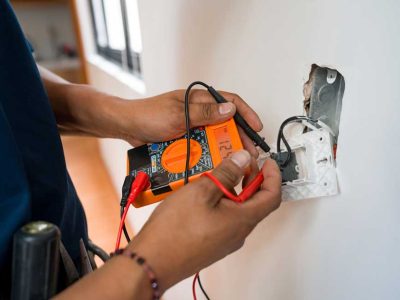
- Terminal Connection Torque: Testing screw terminations on outlets, breakers, and neutral bars to prevent high-resistance micro-arcing.
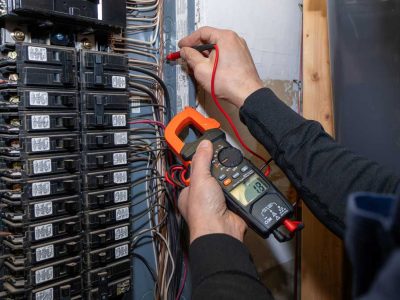
- Panel Load Balancing: Measuring current draw across both 120V hot legs inside the main panel to ensure phase balance under peak usage.
When aging distribution setups reach maximum capacity, review your options for Electrical Panel Upgrades and Electrical Service Upgrades (100A, 200A, 400A).
How Electrical Power Moves Through a Home
Power flows through your residential electrical infrastructure in distinct stages:
- Utility Service to Meter: High-voltage power travels from overhead lines or underground service laterals directly to your electric meter base.
- Meter to Main Panel: Energy flows through main service entrance conductors into your main circuit breaker panel.
- Main Panel to Branch Circuits: The main bus bars divide total power into individual 120V and 240V branch lines protected by circuit breakers.
- Branch Circuits to Outlets & Appliances: Copper conductors route electricity through walls, ceilings, and floors directly to end-use receptacles, lighting fixtures, and dedicated equipment.
Every component along this path must be correctly sized and properly connected to maintain system stability under real-world operating loads. Poor planning, outdated equipment, or improper wiring methods can create performance issues that affect how reliably power reaches different areas of your home.
What Electrical Distribution Actually Means
Electrical distribution is the systematic engineering behind how electricity is:
- Divided into independent branch circuits
- Routed safely through building framing and structural members
- Delivered to individual outlets and equipment
- Managed under fluctuating household power demands
A properly engineered power distribution system handles high current draw without unnecessary breaker trips, maintains consistent voltage for sensitive electronics, allows room for future home additions, and prevents high-demand appliances from interfering with general lighting circuits.
To understand how system capacity is calculated before installing new wiring, review our guide on Load Calculations & Electrical System Planning.
A properly designed system may also require Circuit Upgrades & Expansion when additional electrical demand is added through remodeling projects, new appliances, or modern technology.
Types of Circuits in a Residential System
Residential wiring systems rely on several primary types of branch lines:
- General-Purpose Circuits (15A / 20A): Standard 120V lines supplying general overhead lighting, bedroom outlets, and low-draw electronics.
- Dedicated Circuits: Isolated 120V or 240V lines powering a single specific appliance such as refrigerators, microwaves, sump pumps, or other equipment without sharing power.
- 240V High-Demand Circuits: Heavy-duty double-pole branch lines supplying major continuous loads like clothes dryers, EV chargers, electric ranges, and HVAC heat pumps.
- Critical Load Circuits: Essential circuits isolated for seamless backup power transfer during utility outages.
Modern homes often require more dedicated circuits than older properties because today’s electrical systems support more appliances, electronics, heating equipment, and specialty devices. Adding new demand without evaluating the existing wiring can lead to overloaded circuits, voltage issues, or repeated breaker trips.
For homes that need additional power capacity for specific equipment, explore our Dedicated Circuit Installation services.
How Amperage and Heat Flow Through Wiring
Amperage represents the total volume of electrical current flowing through a copper wire. As household power consumption increases, amperage increases proportionally.
The physical relationship between current and heat is defined by Joule’s law ($P = I^2R$). As amperage ($I$) increases, resistive heat generation ($P$) along copper conductors increases exponentially.
When power demand exceeds physical conductor and breaker ratings:
- Thermal accumulation melts or degrades wire insulation
- Voltage drops significantly between the panel and end outlet
- Circuit breakers trip to prevent electrical fires
Overloaded circuits are often caused by outdated wiring layouts, insufficient circuit capacity, or new electrical demands being added without proper planning. Identifying these issues early helps prevent recurring performance problems and protects the long-term reliability of your electrical system.
To see how we diagnose thermal breakdown, overloaded circuits, and wiring performance issues, explore our guide on Circuit Troubleshooting & Load Issues.
Bundling, Heat, and Real World Installation Limits
This is where installation craftsmanship directly impacts household safety and component lifespan.
Conductor Bundling and Ampacity Derating
When multiple non-metallic sheathed cables such as Romex are tightly bundled or pulled through the same framing hole, trapped heat cannot properly dissipate into surrounding air cavities. The National Electrical Code (NEC) requires conductor ampacity to be reduced when too many current-carrying conductors are grouped together for extended distances.
Running too many cables tightly together increases internal conductor temperatures, accelerates wire insulation breakdown over time, and can contribute to nuisance breaker trips during normal household usage.
Framing Hole Fill Limits
Overcrowding framing holes drilled through wall studs or ceiling joists creates physical stress during wire installation and concentrates heat accumulation. Proper installation requires carefully planned cable paths and appropriate spacing across framing members to preserve airflow and maintain conductor temperature ratings.
In homes throughout Northern Colorado where electrical additions have been completed over many years, correcting overcrowded wiring paths is an important step in improving system safety and performance.
When wiring modifications or additional circuits are needed, our Electrical Circuits & Wiring services help ensure new installations are properly planned, routed, and integrated with the existing electrical system.
How We Install Wiring Differently for Long Term Reliability
At RCI Electric, clean wiring layout is a matter of electrical efficiency and safety rather than cosmetics alone.
Our installation standards include:
- Spacing Conductors Properly: Securing cables along framing members with proper clearance to prevent heat entrapment and ampacity derating.
- Eliminating Overcrowded Framing Holes: Drilling separate, properly sized penetrations through studs and plates to maintain airflow.
- Orderly Panel Wire Management: Routing hot, neutral, and grounding conductors neatly inside the panel box to ensure clean thermal dissipation across breaker bus bars.
- Pre Planning Cable Paths: Mapping distribution runs before pulling wire to minimize cable lengths and prevent unnecessary voltage drop.
A properly organized wiring system improves reliability by reducing stress on conductors, maintaining proper connections, and allowing future electrical upgrades to be completed more efficiently. Whether your home needs new circuits, wiring improvements, or a complete system evaluation, careful planning is essential for long-term performance.
What Evaluates System Distribution Performance
When analyzing a home’s electrical distribution, our electricians evaluate key performance indicators:
- Wire Gauge vs. Circuit Rating: Ensuring 14 AWG wire is restricted to 15A lines, 12 AWG wire to 20A lines, and heavier 10 AWG, 8 AWG, or 6 AWG copper is used for continuous high-draw loads.
- Terminal Connection Torque: Testing screw terminations on outlets, breakers, and neutral bars to prevent high-resistance micro-arcing.
- Panel Load Balancing: Measuring current draw across both 120V hot legs inside the main panel to ensure phase balance under peak usage.
When aging distribution setups reach maximum capacity, your home may require improvements to safely support modern electrical demand. Review your options for Electrical Panel Upgrades and Electrical Service Upgrades (100A, 200A, 400A).
Related Pages
Explore these related service pages to learn more about home power distribution:
- Electrical Circuits & Wiring
- Circuit Troubleshooting & Load Issues
- Circuit Upgrades & Expansion
- Load Calculations & Electrical System Planning
- Electrical Panel Upgrades
- Electrical Service Upgrades (100A, 200A, 400A)
- Dedicated Circuit Installation
Frequently Asked Questions
Electricity flows from utility lines into your meter base, through the main service panel, and out along branch circuit wires to power outlets, switches, lights, and appliances before returning along neutral conductors.
Electrical load refers to the total amount of power, measured in watts or amps, drawn by all active lights, electronics, and appliances connected to an electrical circuit or main panel.
Circuits overload when the total combined current drawn by connected appliances exceeds the safe rated amperage capacity of the circuit conductor and breaker.
A circuit breaker is a safety device designed to protect building wiring from overheating and potential fire hazards by automatically opening the circuit when current draw exceeds safe limits.
Balancing electrical loads evenly across both 120V hot legs inside the panel helps prevent bus bar overheating, reduces voltage fluctuations, and improves overall system efficiency.
Voltage drop is caused by electrical resistance along excessively long wire runs or undersized copper conductors carrying high current, resulting in reduced voltage at the end outlet.
You can add new branch circuits if your main panel has available breaker slots, undamaged bus bars, and enough available amperage capacity based on a proper load calculation.
Older homes were often wired for significantly lower electrical demand and may lack the dedicated circuits required for modern electronics, HVAC systems, appliances, and specialty equipment.
A dedicated circuit is an isolated line running directly from the service panel to a single appliance or outlet, ensuring high-demand equipment receives proper power without sharing capacity with other devices.
Signs of an undersized system include frequent breaker trips, lights dimming when major appliances turn on, warm panel covers, and difficulty adding new appliances without overloading the electrical system.
Recent Projects




Call RCI Electric for Electrical Distribution and Wiring Systems in Northern Colorado
If your home’s electrical system is not performing as it should, the underlying issue is often how the wiring was routed and installed, not just a bad fixture or breaker. At RCI Electric, we evaluate your complete power distribution system, identify physical bottlenecks or thermal risks, and build wiring layouts that handle real-world loads safely for decades to come.
Ready to ensure your home’s wiring is safe, organized, and properly sized? Call (970) 294-1208 or fill out our online form to schedule your service evaluation today.