Whole Home Rewiring for Homes in Northern Colorado
Whole-home rewiring usually doesn’t start with a single dramatic electrical failure. It starts when you realize your entire power distribution system is fundamentally outdated.
In many older residences, that means legacy knob and tube wiring is still actively carrying current, sometimes fully visible in basements or attics, and sometimes hidden behind drywall alongside newer Romex cables.
You might experience:
- Circuits that were never engineered to carry modern appliances
- Wiring that has been repeatedly spliced, extended, or altered over decades
- Modern fixtures or breaker panels layered directly on top of ungrounded 2-wire cabling
Everything in the house might still technically work, but it does not perform reliably or safely under modern electrical loads.
In homes across Longmont, Erie, and Lafayette, this is where piecemeal repairs stop making sense and whole-home rewiring becomes the right long-term solution.
When Fixing It Stops Working
Most homes that eventually require a complete rewire have already undergone years of partial repairs and quick fixes:
- New branch circuits added during minor remodels without a master plan
- Wiring extended into additions by tapping into nearest, already crowded lines
- Quick fixes stacked on top of ungrounded 2-wire systems over time
In many of these homes, legacy knob and tube wiring remains active deep inside wall cavities, even if portions of the visible system appear modern. The result is a patchwork house where individual components work, but the system as a whole struggles to maintain power balance.
What Whole Home Rewiring Actually Means
Whole-home rewiring is not a simple repair. It is a complete electrical reset.
A comprehensive rewiring project includes:
- Replacing all outdated, ungrounded, or deteriorating wire conductors with modern copper NM-B cabling
- Rebuilding circuit distribution from the panel out to every room
- Replacing all receptacles, wall switches, light sockets, and junction boxes
- Correcting unsafe or non-compliant junction splices behind walls
- Evaluating main panel capacity and rebalancing system load across phases
The ultimate goal is creating a unified, code-compliant electrical system engineered for long-term safety and performance. Learn more about conductor distribution with our Wiring Systems & Electrical Distribution services.
Understanding Knob And Tube Wiring Challenges
Legacy knob and tube (K&T) wiring is one of the primary reasons a complete house rewire becomes necessary.
Knob and tube systems were installed from the late 1800s through the 1940s for a fundamentally different era of energy use:
- Designed for minimal lighting and small table appliances
- Built with zero equipment grounding paths (2-wire systems)
- Rated for far lower total amperage continuous draw
Over decades, these systems suffer severe wear:
- Thermal insulation degrades and crumbles from heat, leaving bare copper exposed
- Unqualified modifications add heavy appliance loads onto lightweight 15-amp lines
- Modern thermal attic insulation is blown directly over wires, preventing heat dissipation and creating severe fire hazards
Attempting to extend or tie modern electronics into active knob and tube runs is unsafe and prohibited by current electrical standards. See how grounding affects home safety with our Grounding & Bonding Corrections services.
Why Partial Fixes Don’t Work
Attempting to fix knob and tube or ungrounded wiring room by room often creates more frustration than it solves:
- You cannot reliably expand an ungrounded 2-wire system to support modern electronics
- Installing 3-prong GFCI outlets on ungrounded wire protects against shock, but fails to provide surge or equipment grounding
- Resolving an electrical fault in one room often transfers the load burden to an adjacent, weak circuit
That is why full rewiring is usually the most cost-effective and permanent solution for aging homes.
The Real Problem Legacy Circuit Layouts
In older homes throughout Northern Colorado, the original circuit layout is often worse than the physical wire condition.
Common legacy layout flaws include:
- Entire floors (bedrooms, hallways, and bathrooms) daisy-chained onto a single 15-amp circuit
- High-draw kitchen outlets tied directly into living room lighting lines
- Missing dedicated branch lines for refrigerators, microwaves, or laundry
Whole-home rewiring replaces chaotic legacy layouts with properly separated branch lines: dedicated 20-amp kitchen countertop circuits, dedicated bathroom GFCI lines, and independent lighting runs. Discover how new lines improve performance with our Circuit Upgrades & Expansion services.
Load And System Planning
Rewiring your home provides a clean slate to design power distribution tailored to modern living:
- Sizing branch lines for high-wattage electronics, home offices, and kitchen appliances
- Distributing receptacle loads evenly across multiple breakers to eliminate nuisance trips
- Future-proofing capacity for EV chargers, heat pumps, or basement finishes
Proper load calculations ensure your rewired home operates without power sags or warm wall plates. Read about calculating total capacity with our Load Calculations & Electrical System Planning services.
Panel And Service Considerations
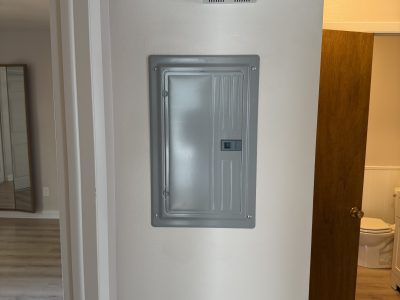
A whole-home rewiring project often reveals that the existing main panel cannot support a modern, code-compliant circuit layout:
- The existing panel is physically full, lacking space for required AFCI and GFCI breakers
- The main service entrance, such as an older 60A or 100A panel, lacks overall capacity
- Bus bars or main lug connections show signs of oxidation or thermal stress
When rewiring, upgrading to a 200-amp main service panel ensures your new branch circuits receive clean, reliable power with room for future growth. Explore service upgrade options with our Electrical Service Upgrades services.
Rewiring During Home Remodels
The most cost-effective time to perform a whole-home rewire is during major kitchen, bath, or main-floor renovations.
When walls and ceilings are open during framing:
- Electricians can drill joists and pull copper lines rapidly
- Wall damage is minimized, drastically reducing drywall repair costs
- Complete code updates, including AFCI/GFCI protection, can be completed seamlessly
Waiting until after drywall is painted makes fishing wires through closed wall cavities significantly more complex and labor-intensive.
Real World Problems We Fix In Northern Colorado
In older neighborhoods across Longmont, Erie, Lafayette, and Boulder County, we routinely address legacy wiring hazards:
- Active knob and tube wiring concealed behind newer Romex splices inside junction boxes
- Ungrounded 2-wire cloth cabling supplying high-end entertainment systems and home computers
- Overloaded branch circuits causing whole-house lights to flicker when refrigerators cycle on
- Buried, uncontained wire splices resting behind drywall without code-compliant junction boxes
- Repeated breaker trips caused by legacy 15-amp circuits operating near 100% continuous capacity
If knob and tube or ungrounded wiring remains part of your home’s infrastructure, repairing small pieces usually just moves the electrical bottleneck to another room.
Related Pages
Explore these related service pages to learn more about home rewiring and power infrastructure:
- Remodels, Rewires & Additions
- Aluminum Wiring Replacement
- Wiring Systems & Electrical Distribution
- Circuit Upgrades & Expansion
- Grounding & Bonding Corrections
- Load Calculations & Electrical System Planning
- Electrical Service Upgrades
Frequently Asked Questions
Signs include persistent flickering lights, frequent breaker trips, warm wall switch plates, burning odors near outlets, ungrounded 2-prong outlets, or the presence of legacy knob and tube or cloth-insulated wiring.
While knob and tube wiring was code-compliant when installed, it is considered unsafe today because it lacks an equipment grounding conductor, features degrading rubber insulation, and was never engineered for modern high-draw appliances.
Yes, provided the system is mapped correctly. However, rewiring the entire house under a single project is generally more cost-effective because it reduces total labor time and eliminates hazardous splices between old and new wiring.
Not completely. Professional electricians use specialized wire-fishing techniques, flexible drill bits, and small access cutouts to run new cables through existing walls with minimal drywall disruption.
In most cases, yes. Modern electrical codes require combination AFCI/GFCI breakers on almost all residential circuits. Older panels often lack the physical space or neutral bar capacity to accommodate these advanced safety breakers.
Standard insurance policies usually do not cover elective rewiring. In fact, many insurance carriers in Colorado will deny coverage or charge significantly higher premiums if a home contains active knob and tube wiring.
Timeline depends on home size, wall construction, and access, such as unfinished basements or attics. A standard 2,000-square-foot home typically takes 3 to 7 working days to complete full rewiring.
High-draw appliances like microwaves, space heaters, and portable AC units quickly overload legacy 15-amp circuits, causing severe heat buildup, voltage drops, and active fire risks.
Ungrounded 2-wire cable contains only a hot and neutral conductor, leaving electronics vulnerable to surges and shock. Modern NM-B Romex includes a dedicated bare copper grounding wire to safely channel fault currents back to the panel.
Yes. Whole-home rewiring requires official electrical permits, plan reviews, and mandatory rough-in and final inspections from local municipal or state electrical inspectors.
Recent Projects





Schedule Professional Whole Home Rewiring Services
Whole-home rewiring isn’t about fixing one minor symptom. It is about resetting your electrical system for absolute safety, performance, and peace of mind. At RCI Electric, we design and install clean, fully code-compliant wiring systems built to support modern living for decades to come.
Call (970) 294-1208 or fill out our online form to schedule your expert service evaluation today.