Why Is My Lighting Causing Breaker Trips? Lighting Load & Circuit Issues in Homes in Northern Colorado
When a circuit breaker trips the moment you switch on a light, or after your lights have been running for twenty minutes, it is never a random occurrence.
Because modern LED lighting typically draws very low amperage, lighting circuits rarely push an electrical system hard on their own. When flipping a light switch starts causing breaker trips, something fundamental in the underlying circuit has changed:
- More light fixtures were added to the circuit over time
- Lighting was tied into shared circuits carrying high-demand appliances
- Wiring connections or switches are overheating under sustained demand
Around Boyd Lake and nearby communities like Loveland and Berthoud, this issue frequently appears after lighting has been expanded without evaluating how the branch circuit handles total electrical load.
What Is Actually Happening
A circuit breaker trips to protect your home’s wiring from overheating or catching fire when electrical limits are exceeded.
Breaker trips caused by lighting generally happen for three reasons:
- Excessive Amperage Draw: Total current on the branch line exceeds the breaker’s rated limit (15-amp or 20-amp).
- Thermal Overload: Sustained current draw builds heat over time inside an aging breaker or overloaded junction box.
- Short Circuit or Ground Fault: A hot wire contacts a neutral wire or grounded metal box, triggering an instant magnetic trip.
The breaker itself is rarely defective. It is doing its job by cutting power to an unsafe or unstable circuit. Learn more about general breaker issues: Why Your Breaker Keeps Tripping.
Common Causes of Lighting-Related Breaker Trips
Overloaded Lighting Circuits
Adding extra recessed lights, high-output shop fixtures, or exterior floodlights onto an existing 15-amp lighting circuit increases total continuous wattage. Eventually, the combined load pushes the circuit past its safe operating threshold.
Shared Circuits
In many Northern Colorado homes, lighting circuits are improperly shared with wall outlets, garage power tools, kitchen appliances, or bathroom exhaust heaters. When a microwave, space heater, or power tool turns on while the lights are burning, total demand exceeds the circuit capacity and trips the breaker.
Wiring and Connection Issues
Loose wire nuts inside ceiling junction boxes, nicked insulation behind drywall, or corroded switch terminals can create high resistance or intermittent short circuits. Under load, these bad connections heat up and cause the breaker to trip. Explore how we diagnose branch lines: Circuit Troubleshooting & Load Issues.
Fixture and Driver Failures
Integrated LED drivers, fluorescent ballasts, or transformer power supplies inside light fixtures can develop internal electrical shorts as they age, drawing irregular spikes of current that instantly shut down the breaker.
Dimmer and Control Issues
Overloading a wall dimmer switch past its maximum wattage rating or pairing non-dimmable fixtures with electronic dimmers generates extreme heat inside the switch box, leading to circuit instability. Read about wall switch controls: Basic Devices & Switching Systems.
Breaker Trips Under Different Conditions
The exact timing of a breaker trip provides valuable clues about what is failing inside your electrical system.
Trips Immediately Upon Flipping The Switch
An instant trip indicates a hard fault, such as a direct short circuit between hot and neutral wires, a ground fault inside a metal fixture box, or a shorted fixture driver.
Trips After 10 To 30 Minutes Of Use
A delayed trip points to thermal overload. As the lights run, heat gradually builds up along undersized conductors or inside a maxed-out breaker until the internal thermal strip expands and trips the switch.
Trips Only When Other Appliances Turn On
This pattern confirms a shared circuit issue. The lighting load alone may not trip the breaker, but when a refrigerator compressor, vacuum, or space heater cycles on, the combined amperage spikes past the safety limit.
Lighting As Part Of Total Circuit Load
Lighting does not operate in isolation. It shares electrical distribution with the rest of your home.
Even when converting older fixtures to low-wattage LEDs, adding dozens of new fixtures across a main floor or basement finishing project increases the baseline load on your panel. If your branch lines are already operating near 80% continuous capacity, adding “just a few more lights” can push the entire circuit over the edge.
What We Check When Diagnosing Lighting Breaker Trips
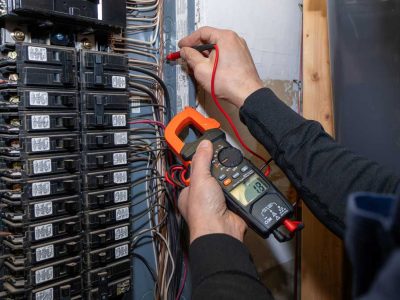
At RCI Electric, we perform comprehensive circuit testing to pinpoint why your lighting is triggering breaker trips.
System-Level Review
We test overall service panel capacity, check total demand across both hot legs, and evaluate panel bus bar condition.
Circuit-Level Inspection
We verify breaker sizing against wire gauge (#14 AWG for 15A, #12 AWG for 20A), measure live operating amperage, and trace whether the line is dedicated or shared with outlets.
Load Interaction Diagnostics
We test circuit response while turning on secondary household appliances, identifying overlapping loads and power spikes.
Fixtures And Controls Testing
We inspect wall switch terminals, test dimmer compatibility, check LED driver health, and torque connection points inside junction boxes.
Real-World Problems We Fix In Northern Colorado
In areas around Boyd Lake, Loveland, Windsor, and Berthoud, we frequently resolve lighting breaker issues:
- Recessed lighting added during basement remodels tied into already maxed-out main floor circuits
- High-output garage shop lights wired onto shared outlet lines that trip when air compressors start up
- Incompatible wall dimmers causing thermal shutoffs inside switch boxes
- Older home wiring where adding modern exterior security lights pushed legacy 15-amp circuits over capacity
When Lighting Breaker Trips Indicate A System Upgrade
If resetting a breaker results in immediate trips or if lighting across multiple rooms causes panel shutoffs, the issue extends beyond replacing a light switch.
When your electrical panel lacks available circuit space or cannot support your home’s total continuous lighting and appliance load, installing new dedicated lighting circuits or performing a panel upgrade is the permanent solution. Learn about expandability: Circuit Upgrades & Expansion.
Related Pages
Explore these related service pages to learn more about home lighting performance and breaker troubleshooting:
- Lighting Installation & Upgrades
- Lighting Problems & Troubleshooting
- Breaker Replacement & Electrical Panel Repairs
Frequently Asked Questions
Yes. Light fixtures can trip breakers if they have internal component short circuits, if too many lights are installed on one line, or if the circuit is shared with heavy household appliances.
An immediate breaker trip is usually caused by a direct short circuit, a loose wire touching a grounded metal electrical box, or a shorted wall switch.
Yes. Overloaded dimmer switches, dimmers wired incorrectly, or dimmers paired with incompatible non-dimmable light drivers can overheat and trigger a breaker trip.
Yes. While the breaker tripping is a protective safety measure, repeated trips indicate active thermal stress, overloading, or short circuits that can damage wiring and create fire risks.
If your existing lighting circuits are already operating near maximum continuous capacity, installing a new dedicated 15-amp or 20-amp circuit for new lights is required.
A delayed trip is caused by thermal accumulation. As electric current flows continuously, heat builds up in overloaded wire conductors or an aging breaker until it reaches its thermal tripping point.
While individual LED lights draw low wattage, adding many LED fixtures to an already crowded circuit, or using low-quality drivers that create voltage spikes, can trigger breaker trips.
Yes, if your lights share a branch line with wall outlets. Turning on a vacuum, space heater, or power tool on that shared line can push total current past the breaker limit.
In most cases, the breaker is functioning correctly to protect overloaded or shorted wiring. Replacing the breaker without fixing the underlying load issue will not solve the problem.
The most common cause is an overloaded or shared branch circuit where expanded lighting demand clashes with heavy household appliance loads.
Recent Projects

Schedule Professional Circuit Diagnostics With RCI Electric
If your lighting is causing circuit breaker trips, the issue is not random. It is your electrical system reacting to overload or wiring faults. At RCI Electric, we diagnose lighting and circuit issues at the source so the problem is fixed safely and permanently.
Call (970) 294-1208 or fill out our online form to schedule your expert service evaluation today.